Guide to North Dakota Marriage Records
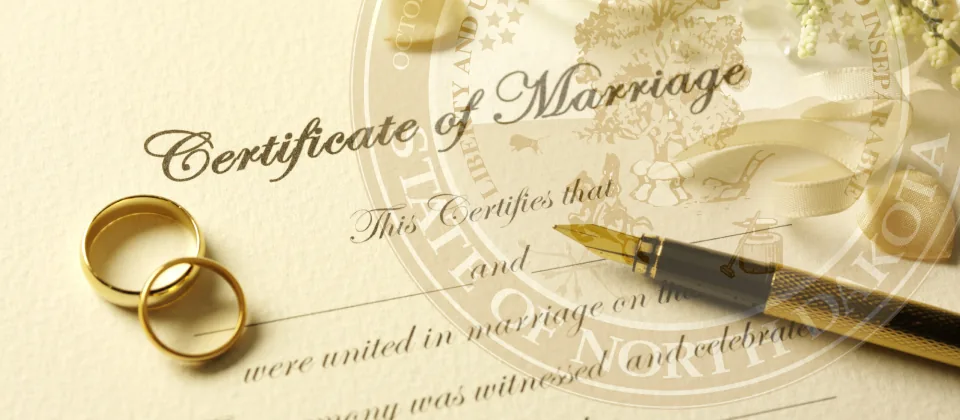
A marriage record is the official record that proves the union of two individuals. Such records usually include the names of the spouses, the date and place of the marriage, and the officiant. However, older marriage records may contain more details, sometimes indicating the spouses' ages at the time of marriage and their parents' names.
In accessing marriage documentation, people sometimes refer to the “marriage record,” “marriage certificate,” and “marriage license” interchangeably. However, they are not the same. A marriage license is a document that allows you to marry legally. A marriage certificate is a document you receive after the ceremony, signed by the officiant, confirming that you are officially married. A marriage record refers to all official documentation maintained in relation to a marriage.
There are many reasons why you may need to find or obtain a marriage record. The commonest reason is to use the marriage record as proof of marital status. They are also used by historians and people researching their family tree to track ancestral timelines.
Types of Marriage Records in North Dakota
| Record Type | Purpose | Issued By | Validation/Notes |
|---|---|---|---|
| Marriage license | Authorizes a couple to marry. | County recorder or clerk of court. | Valid for 60 days. |
| Marriage certificate | Provides official proof that a marriage took place. | County recorder or the office that filed the license. | Required for official name changes and immigration filings. |
| Historical marriage record | Used for genealogy and historical research. | State Historical Society of North Dakota / County Archives. | State Archives provides an online index and holds many pre-1925 county records. |
North Dakota marriage records are typically issued in the following forms:
Marriage Certificates
The marriage certificate is a legal document that serves as proof of marriage. It contains the couples' names, the dates, and the county where the document is registered, and also includes the signatures of both parties involved and the marriage officiant.
Generally, people need a certified copy of their marriage certificate as proof of a marriage-based name change when updating their passports and driving licenses.
Certified copies of marriage certificates are issued by the county office that issued the marriage licenses in North Dakota.
Marriage Licenses
A marriage license is the legitimate approval from the state that permits two individuals to get married. The marriage license is unlike a certificate in that it needs to be obtained beforehand (as opposed to afterward).
North Dakota marriage licenses are issued by the county recorders or other official designated by county commissioners. They are valid for 60 days.
Are Marriage Records Public in North Dakota?
According to North Dakota law, marriage records are public and accessible to anyone. However, a certified copy of the marriage record can only be obtained by the parties involved in the marriage, their family members, or their attorneys.
Moreover, personal information contained in marriage records, such as Social Security numbers are not publicly disclosed since they are classified as confidential under N.D.C.C. § 44-04-28.
What Information Is Included in a Marriage Record?
A standard North Dakota marriage record includes:
- Full names of both spouses (including maiden names)
- Ages of the spouses
- The dates of birth
- Marriage license issuance date
- Marriage ceremony date
- The county or city where the marriage took place
- Names of the witnesses
- Name and signature of the marriage officiant
To protect against identity fraud and ensure privacy, Social Security numbers included in the marriage license applications are not publicly disclosed.
How to Find Marriage Records in North Dakota
Step 1: Identify the Marriage Details
It is important to first gather important information about the marriage. This includes the full names of the people involved and any previous names, if there are any. Additionally, identify the date (or approximate date) when the marriage occurred and the county where it took place.
Step 2: Find the Record Custodian
North Dakota marriage record custodians vary based on the wedding date. If the wedding took place after July 1925, the North Dakota Department of Health and Human Services maintains a centralized index.
However, the NDDHHS does not issue certified copies of marriage certificates. For those and other marriages that occurred before 1925, contact the specific county recorder or clerk of court where the marriage license was originally filed. Older marriage records are maintained in the State Archives.
Step 3: Choose How to Search
There are various ways to find North Dakota marriage records. For example, if you want to verify marriage information, you may use the state's public indexes or county lookup tools online.
If you need a physical copy, you can send a request by mail or visit the county courthouse to file it. Another option is to use approved third-party databases to find historical marriage indexes.
Step 4: Submit a Record Request
If you want to request a certified copy of a marriage certificate, you will have to fill in an application form and present a valid ID. In addition, you must pay the appropriate processing fee, which varies by county.
Processing time usually lasts several business days; in-person requests are often handled on the same day. Note that uncertified copies are typically good for research, while certified copies cost more but are required for legal or official business.
How to Get a Certified Marriage Certificate in North Dakota
You can obtain a certified marriage certificate in North Dakota from the county where the marriage license was purchased and filed. Note that the procedure for obtaining this record differs by county. While some offices accept in-person requests, others accept mail requests, and others offer online ordering options. For mail requests, you must submit a completed application form provided by the county.
Still, generally, you have to present a valid government-issued photo ID, such as a driver's license or passport, to verify your identity. You also have to pay the applicable fee, which ranges from $5 to $10 for the first copy. For instance, both Grand Forks and Cass counties charge a $10 fee for the first certified copy of a marriage certificate. Depending on the county, minor discounts may apply for additional copies ordered at the same time.
Note that certified copies of marriage certificates are required for processes such as proving a legal marriage, establishing eligibility for benefits, and updating a name with the Social Security Administration or a driver's license.
How to Get a Marriage License in North Dakota
Marriage licenses are obtained from county recorder offices across North Dakota. The law stipulates that the county recorder is responsible for issuing the license unless the county commissioners appoint an alternative official to perform the duty.
Applicants are required to provide proof of identification and age (such as a driver's license, state ID, certified birth certificate, or passport) before completing their application. North Dakota sets an age limit of 18 for individuals seeking to marry. However, a person who is aged 16 or 17 can be issued a marriage license with parental or guardian consent. North Dakota prohibits marriage to people under 16. Furthermore, if the applicant has been previously divorced, they must also submit a certified copy of the final divorce decree or death certificate.
North Dakota does not impose a residency requirement for a marriage license applicant. There is also no waiting period, which means couples can obtain their license and marry on the same day. The license is valid for 60 days after the date of issue.
The statutory fee for a North Dakota marriage license is $65. Be aware that just obtaining a marriage license is not enough to complete the marriage. A marriage ceremony must be held and performed by an authorized officiant, with the couple and at least two witnesses present. Authorized marriage officiants in the state include judges, municipal judges, recorders or designated officials, qualifying clergy, and individuals authorized under the rituals and practices of a religious persuasion.
Who Can Request Marriage Records?
Since marriage records are public information in North Dakota, anyone can ask to view or search the basic public indexes.
However, North Dakota restricts official certified copies to specific people:
- The spouses listed on the certificate
- Immediate family members (parents, children, siblings)
- Authorized legal representatives or attorneys representing the couple
- Government agencies requiring the document for official duties
Be aware that for third-party requesters, access to a marriage record does not override confidentiality laws. Hence, details such as Social Security numbers remain confidential.
Free and Online Marriage Record Searches

You may use the online public index marriage resource provided by the State Historical Society of North Dakota to access historical marriage information for free. County websites also offer some online tools to help users access basic free information. Additionally, genealogy platforms like FamilySearch provide users with access to digitized, uncertified marriage records.
However, these resources only reveal basic facts about marriages, such as names, marriage dates, and the counties where the marriages were registered. These records cannot be used as official documents. If you want access to a marriage record for the purpose of proving marital status for a legal action, you must pay the fee to obtain a certified copy from the county recorder.
When searching for a marriage record and you do not know the county or date of the marriage, try searching the state's historical marriage index using the groom's or bride's last name. Additionally, consider searching neighboring counties where the couple lived or worked, as some people may have obtained their marriage licenses from courthouses in those counties rather than the one where they reside.
Common Law Marriage in North Dakota
In North Dakota, couples are not allowed to create common-law marriages by living together and acting as if they were married. Per the state supreme court, no number of years of cohabitation automatically makes a couple legally married.
If the common-law relationship was created elsewhere where common-law marriages are valid, it may be legally recognized in North Dakota. An individual claiming to be in a common-law marriage may need to establish that the union satisfied the law in the jurisdiction where it was created.
If a common-law marriage was created in another jurisdiction, you cannot access a conventional marriage record for it in North Dakota, as no marriage license or certificate was issued for it in the state.
How to Correct an Error on a Marriage Record
Mistakes may occur in names, dates, places, or any other entered information when preparing a marriage application or marriage certificate. The spouse named on the record or the marriage officiant is typically the individual who requests an amendment to a marriage record. However, a representative or attorney for a spouse named in the record may also be able to do so on their behalf.
To amend a marriage record, an application, and supporting evidence must be submitted to the county authority that issued and registered the marriage license. Depending on the type of correction required, the supporting documentation needed will vary. Examples include a certified copy of a birth certificate, passport, military record, or baptismal record.
Although minor typographical mistakes can be fixed quickly for a nominal fee, more significant errors may require court approval, incur substantial fees (including court fees), and take several months to resolve.
Marriage Records and Name Changes
The marriage law in North Dakota permits a person to choose from different surname options when applying for a marriage license.
As a spouse, you may retain your previous surname, adopt your spouse's surname, use a surname that either of the spouses has previously had, or use an allowed combined surname. Also, there are several options for changing a middle name at the time of marriage.
When an allowable new surname is entered as part of the marriage process, the marriage certificate can serve as proof that use of the new surname is lawful.
You can then use a certified copy of the marriage records as proof of a marriage-based name change to update your record with the Social Security Administration (to acquire an updated Social Security card) or the driver's license office. Both offices typically require a certified marriage record for a name change related to marriage.
Changing a name after marriage is not the same as correcting an error on a marriage record. A correction fixes information that was recorded incorrectly. A name change reflects the person's legal choice of name.
Marriage Records for Genealogy and Family History
Marriage records in North Dakota are useful for genealogy research because they provide information about marriages that helps connect spouses, including the marriage date and location, which would otherwise be difficult to trace.
For historians and genealogists, a crucial place to start to search older marriage records is the North Dakota State Historical Society, as its online marriage index combines records from two periods. First, pre-1925 records are sourced from the State Archives holding, while post-1925 to the present records are based on information provided from North Dakota Vital Records.
As for the marriages that took place before 1925, the State Archives holds the records in microfilm for many counties. However, for some pre-1925 county marriages, researchers may need to contact the county directly.
The State Archives provide additional resources that may help to fill the gaps in a family history. These include newspapers, census material, manuscripts, local records, and other archival collections. Details available from these sources may help fill in the gaps in the official marriage certificate.
FamilySearch also provides various options regarding older North Dakota marriage records, including the county marriage index starting from 1870. Ancestry does the same as FamilySearch and can be useful when the same person needs to be followed across census, birth, death, military, immigration, and other records.
Searching by both spouses' names is often more effective than searching by either spouse's name. Moreover, when the exact date of marriage is unknown, it is recommended to try a range of several years. Also, consider searching by maiden names, alternate spellings, and initials, and neighboring counties.
It is, however, important to note that there may be some limitations in older marriage records. The State Historical Society states that not all pre-1925 marriage records from all counties have been fully indexed. Hence, a failed online search result should not necessarily lead to the conclusion that the marriage has not been recorded.
In such a case, consult the county courthouse, State Archives, church records, newspapers, cemetery records, and other local sources to find the missing evidence.
Frequently Asked Questions
Are marriage records public in North Dakota?
Yes, marriage records are considered public documents. Anyone can access public indexes to find information about marriage records, but the certified copies of the record will be issued only to certain persons, such as the couple, close family members, and authorized representatives.
How can I find a marriage record by name?
You can use free databases, including the North Dakota State Museum index or a genealogy service, where you can search by inputting the names of the spouses.
Can I search marriage records online for free?
Yes, it is possible to obtain historical records and basic details free of charge from the State Historical Society website and platforms like FamilySearch.
How much does a marriage certificate cost?
Depending on the county, a certified copy of a marriage certificate typically costs between $5 and $10, with additional copies ordered at the same time costing less.
How long does it take to get a certified marriage certificate?
If you apply for your marriage certificate directly at the county office, you can get it on the same day. Requests by mail or online take, on average, a couple of weeks.
Can someone else request my marriage certificate?
Anyone can get general information about your marriage, but cannot obtain a certified copy of the marriage certificate unless they are your immediate family or are authorized by you to do so.
What is the difference between a marriage license and certificate?
A marriage license is a legal document that allows you to marry, while a marriage certificate is a signed document created after marriage proving that you are legally married.
Table of Contents
- Types of Marriage Records in North Dakota
- Are Marriage Records Public in North Dakota?
- What Information Is Included in a Marriage Record?
- How to Find Marriage Records in North Dakota
- How to Get a Certified Marriage Certificate in North Dakota
- How to Get a Marriage License in North Dakota
- Who Can Request Marriage Records?
- Free and Online Marriage Record Searches
- Common Law Marriage in North Dakota
- How to Correct an Error on a Marriage Record
- Marriage Records and Name Changes
- Marriage Records for Genealogy and Family History
- Frequently Asked Questions